UK heavy equipment rental trends: What major contractors should know for 2026
Categories that this article has been filed under.
While 2026 may have started slowly for the wider UK construction market, for us at Stevens Equipment Rental, the acceleration has been phenomenal. Demand for our fleet has been off the charts, making our 50th anniversary a truly transformational year for the business. We’ve added a record number of new machines, opened a southern depot in Northamptonshire, and expanded our team of support staff across the country.
This period of intense activity has given us a unique, front-line perspective on the pressures and priorities major UK contractors are facing. As we look ahead, we wanted to share our analysis of the trends we see shaping 2026, and the proactive steps we’re taking to ensure our customers are ready to meet them.
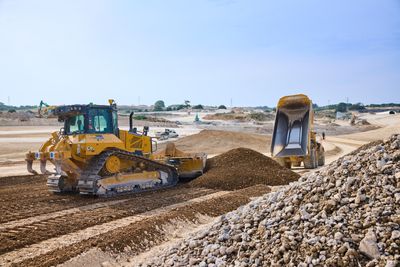
Trend 1: Uncertainty is fuelling a rental shift (and a coming squeeze)
In a stop-start economy, contractors are choosing the flexibility of equipment rental over the long-term liability of ownership.
"When you’re looking at a multi-million-pound investment in new equipment, you have to ask yourself, ‘Can I guarantee that there’s enough work to pay for this asset for the next five years?’" says Mark Need, SER’s sales manager for the North and Scotland. "If that answer is even a little bit shaky, the smart move is to go down the hire route. You get the machine for the contract duration, and then you hand it back with no further liabilities. It’s a very logical way to manage risk."
This isn’t just for smaller firms. Even the largest contractors are using rental as a strategic tool to cover peak demand. As Ben Beard, sales manager for the South, explains: "If you need 20 trucks for a project, you don’t go out and buy 20 trucks. Even the big guys will typically own half and rent the other half to manage capital and cover off liabilities."
We experienced this shift firsthand as a wave of projects kicked off simultaneously in 2025 and if everything planned for 2026 goes ahead, there will be a rush for equipment in the UK rental market.
Our response: Proactive, premium fleet expansion
To meet demand, we’ve been investing heavily in new equipment from premium brands all year, taking our rental fleet to the largest it has ever been in our 50-year history, with more planned for 2026.
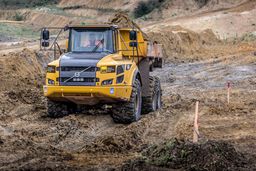
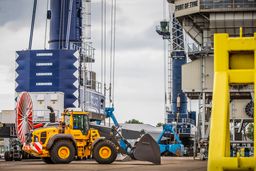
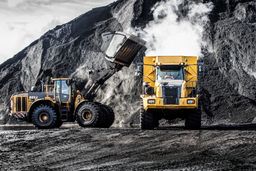
This growth isn’t just about numbers; it’s also about the range of equipment we offer. While we built our reputation as specialists in articulated dump trucks and loading shovels, we have deliberately broadened our offer with excavators, dozers, and soil compactors.
By offering a well-rounded package of the very best equipment, we can act as a single-source partner for our customers’ earthmoving needs, saving them the time and logistical headaches of dealing with multiple suppliers.
Trend 2: Blended fleet strategies are leading to more equipment moves
As contractors increasingly rely on rental to supplement their core fleet, we’re seeing them put their own machines on their most secure, long-term projects to maximise utilisation. They’re then turning to the flexibility of the rental market to cover the shorter, more sporadic jobs, plugging gaps in their programmes without the long-term commitment.
A direct consequence of this trend is a more dynamic, faster-paced rental market. "We’ve definitely seen an increase in transport movements this year," Ben notes. "Our kit is moving between different customer sites more frequently, which tells us that contractors are using rental strategically to remain agile, and it’s our job to provide that seamless, responsive support."
Our response: Increased logistics capabilities through new depots
We have made significant investments in our national logistics network, ensuring we can move machines efficiently between sites, wherever they are in the UK. For example, the opening of our new southern depot in Northamptonshire, complementing our Cumbrian headquarters, enables us to respond more quickly to the needs of customers across the midlands and the South. We also have a third depot planned for Scotland in 2026.
Trend 3: Productivity pressures are favouring larger machines
It’s not just the number of machines on hire that’s increasing; it’s their size. When many projects are being green lit at around the same time, contractors are looking for ways to get more productivity out of every single asset.
"When contractors have huge volumes to move and tight deadlines to hit, the only way to square that circle - especially with a shortage of good operators - is to go big," Ben explains. "One operator in a 50-tonne excavator or 45-tonne hauler can have a massive impact on the productivity of the entire site."
The sheer scale of today’s projects is also a factor as a lot of activity in the UK construction industry right now is focused on infrastructure. "The nature of these jobs demands bigger kit," Mark says. "You can’t build a wind farm or tackle a major highway upgrade with smaller machines. The size of the work itself is pushing the industry into a larger class of equipment."
Our response: Heavy-duty equipment investments
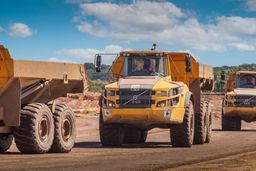
The trend towards larger equipment suits us perfectly, because the big stuff has always been our niche at SER and we have continued to focus our investment in this area. For example, we’ve added the heavy-duty Cat D7 dozer to our fleet for the first time, as a direct result of customers needing more pushing power for major earthworks. It’s also why we’ve focused new articulated hauler deliveries on high-capacity models such as the Volvo A45, which can move significantly more material per cycle.
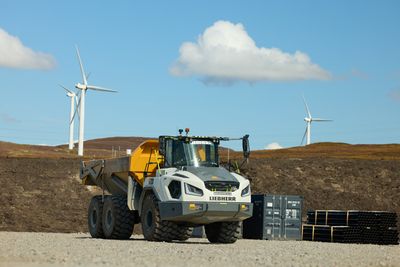
Trend 4: Scotland is becoming a powerhouse of UK construction activity
While 2025 has been busy for SER nationwide, nowhere is the scale and intensity of projects more evident than in Scotland. The region has a strong pipeline of renewable energy projects for the next decade, along with associated housing and road construction.
"We’ve got machines on a lot of projects related to wind farms and substations and they all require supporting infrastructure. Hence, we’re also supplying equipment for the dualling of the A9 between Perth and Inverness, for example," Mark says.
Our response: Dedicated staff and facilities in Scotland
We recognise that supporting Scottish projects effectively requires more than just sending machines north from our Cumbrian headquarters; they need dedicated, local support. That’s why we’re making direct, long-term investments in Scotland. We have already expanded our team of Scotland-based service engineers to provide rapid, on-the-ground support and are in the advanced stages of planning a new, fully equipped depot in Scotland. This will give our customers faster access to our full range of equipment and services.
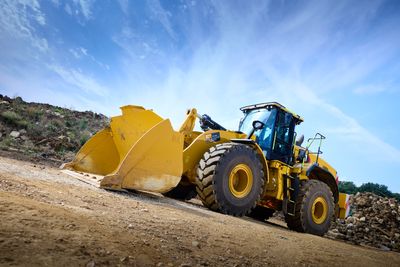
Trend 5: Contractors are increasingly requesting the latest safety tech
A few years ago, advanced safety systems were a niche requirement for rental machines. But with today’s market being driven by major, often publicly funded infrastructure projects, the highest safety standards are no longer optional. Safety features have become the ‘door opener’ to getting onto a site - whether for tier one contractors or the tier two contractors supporting them.
"Until relatively recently, contractors might have arranged to fit things like human form detection (HFD) or a thumbs up kit themselves," Mark says. "Now, they’re asking us, ‘Can you provide a machine with this already on it?’ Because they know it would save them a huge amount of hassle and potential delays."
Our response: Safety features fitted as standard from the yard or the factory
We’re rolling out a suite of advanced safety features across our fleet as part of our premium ‘SER spec’. This includes 360° cameras and HFD systems that help operators overcome blind spots and a digital thumbs up kit that isolates the drive function when the operator signals it’s okay to approach. On our larger loading shovels, we’re also fitting reverse-by-braking systems that can automatically stop the machine if someone gets too close.
In addition, we’re proud to be the first customer of Finning UK & Ireland to take a Cat 972 wheel loader with Caterpillar’s factory-fit Collision Warning System, which combines object and people detection with a ‘motion inhibit’ feature.
With this technology offered as standard, SER machines can roll off the transport and straight onto the strictest sites, meeting the criteria from day one with no fuss.
Trend 6: Sustainability efforts remain pragmatic
While sustainability is on everyone’s agenda, demand for electric machines in the heavy-duty segment of the equipment rental market isn’t there yet.
"The industry is rightly excited about the long-term potential of electrification but for large-scale earthmoving projects, commercially viable solutions are still in their infancy," Ben explains.
Our response: A young fleet with the latest Stage V engines
We are closely monitoring electric machine advances and are expecting to have initial results from our hydrogen fuel cell trials in Q2 2026. However, the single most impactful thing we can do for our customers’ environmental performance at this point in time is to run an exceptionally young fleet. By investing in brand new machines with the latest Stage V engines, we guarantee they are using the most fuel-efficient, low-emission diesel technology ever built.
"The manufacturers have spent millions making these engines as clean and efficient as they can be," Mark says. "Taking this ‘best-in-class-today’ approach is the most effective way we can help our customers to reduce environmental impact, without compromising on the productivity and profitability their projects demand."
Conclusion: In a challenging market, the smartest choice is the lowest risk
When faced with economic uncertainty and ever-higher demands for productivity, safety, and sustainability, contractors are rightly focused on reducing their overall project risk. The real financial danger isn’t the weekly hire rate; it’s a machine not being available when promised, not meeting safety standards, or breaking down on site.
This is where the SER business philosophy comes into focus. Our strategy is to be the lowest-risk partner in the market. We do this by providing a young, premium fleet, specified and purchased according to direct customer feedback. This is all supported by a responsive service team and a structure where our customers have a direct line to senior management.
By listening to our customers and investing ahead of the curve, we’re not just preparing our business for 2026; we’re ensuring our partners have the certainty and the advantage they need to succeed.
The challenges of 2026 demand a reliable rental partner. If you’re planning a project and want to ensure you have the right high-spec, low-risk fleet in place, we’re ready to help.